AI in Wealth Management
What Makes Glynac AI Different from Generic AI Tools for RIA Compliance Automation?
Rahul Sinha
5 mins
AI in Wealth Management
Discover how Glynac AI differs from generic AI tools for RIA compliance automation by delivering audit-ready workflows, centralized compliance intelligence, scalable oversight, and explainable AI built specifically for wealth management firms.
Compliance in 2026 is not a side task anymore. The SEC has pushed Regulation S-P into a new phase, and firms are feeling it fast, especially when spreadsheets and random folders are still doing the heavy lifting. Stratifi says 70% of RIAs are increasing compliance tech spend this year, and that tells you the old setup is already losing ground.
That is where Glynac AI comes in. It is a US-based compliance software company built to handle RIA compliance automation without the fake polish generic tools love to sell. Glynac AI connects CRM data, custodian activity, advisor communication, and filings into one layer, so your team sees risk early instead of chasing it later.
Generic AI looks useful until the work gets serious. It can draft a note or summarize text, but it falls apart when a compliance team needs context, traceability, and actual regulatory judgment.
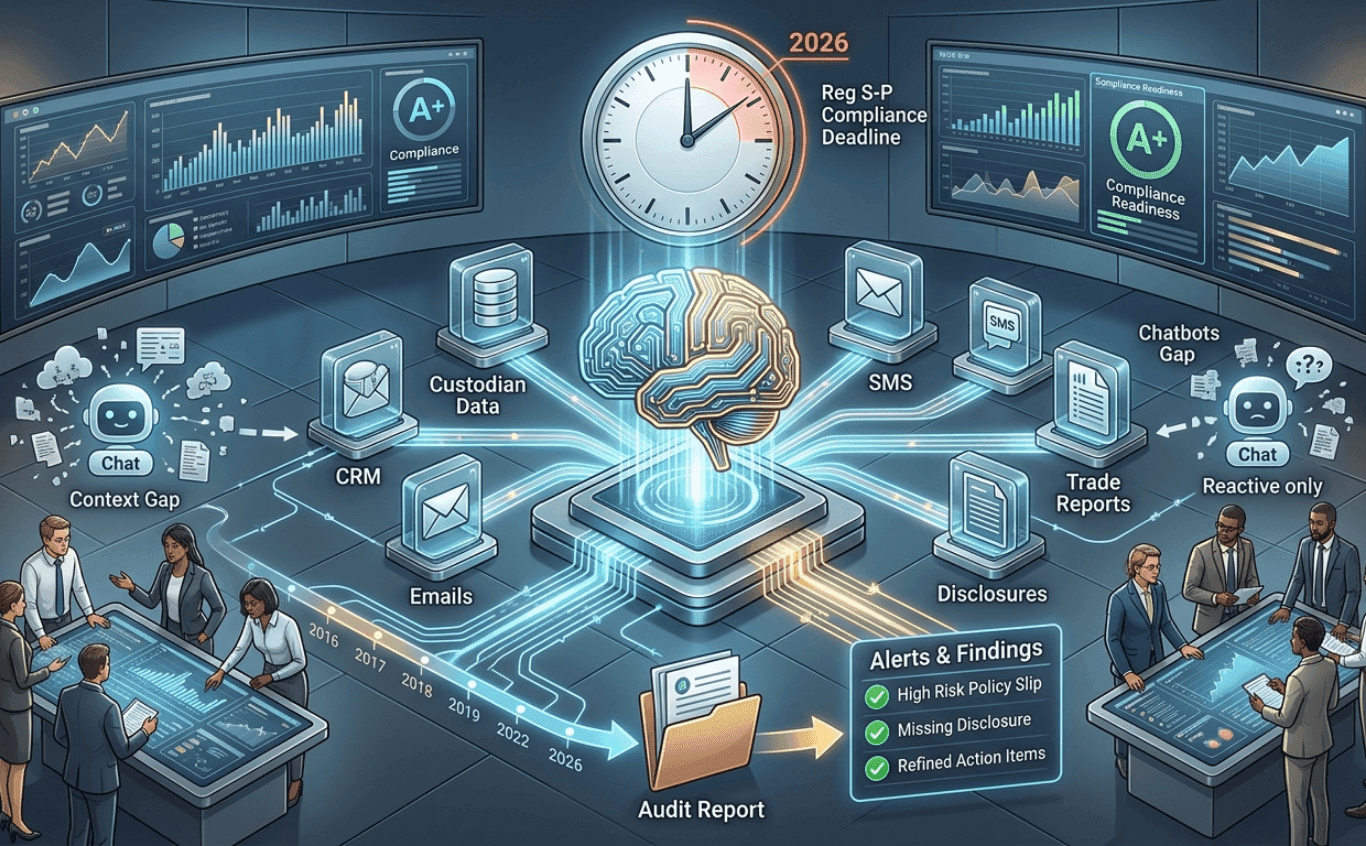
Generic AI cannot naturally connect a CRM note, a trade exception, and an email thread into one clean story. That is a problem, because compliance issues usually live across those exact places. Glynac AI was built around wealth management workflows, so it can tie those pieces together without acting confused.
It gets worse when the issue involves Reg BI, fiduciary conduct, or a Form ADV mismatch. Tools like ChatGPT or Copilot were never built for that kind of work, and regulators know it. WealthManagement also makes it clear that exam priorities keep getting sharper, not softer.
The last problem is explainability. If an AI flags something, a compliance team still has to show why. A black box answer is not much help when someone asks questions during an exam.
The real mess is not a lack of text generation. It is the fact that data is scattered across custodians, CRMs, email, portfolio systems, and shared drives. A chat window does not fix that, no matter how slick it looks.
Glynac AI acts more like an audit-ready compliance documentation tool than a chatbot. It creates searchable records, cleaner timelines, and a trail that is actually useful when someone asks for proof. That is the part generic tools usually pretend does not matter.
The difference is simple. Generic AI answers questions after the problem shows up. Glynac AI helps surface the issue while it is still manageable.
Glynac AI is not a plugin with a finance name slapped on top. It is a compliance intelligence platform for wealth management that is meant to fit how real firms work, not how a demo deck looks. That matters, because the real job is messy.
A lot of compliance pain comes from fragmentation. One system holds trades, another holds notes, another holds disclosures, and the CCO ends up stitching together the whole story by hand. Glynac AI pulls those pieces into one place.
That makes pattern detection a lot easier. Missing documentation, billing mismatches, and disclosure gaps are easier to catch when the data is already connected. It also turns slow file chasing into something a team can review without wasting half a day.
The payoff is speed without losing the paper trail. Instead of building timelines one screenshot at a time, Glynac AI reconstructs them in minutes. That alone saves a ton of dull cleanup.
Communication review is where weak tools get exposed fast. Emails, SMS, Slack, and call transcripts all carry risk, but generic tools often just hunt for keywords and miss the meaning. That is not enough for modern oversight.
Automated communication surveillance for RIAs needs context, not just a word list. Glynac AI flags risky language, guarantee claims, and policy slips with enough surrounding detail to be useful. McGuireWoods also points to FINRA’s stronger focus on AI and cybersecurity, which makes this even more important.
That is the difference between a helpful alert and another noisy inbox. If the tool only screams about random phrases, your team stops trusting it. Glynac AI is built to avoid that trap.
Growth changes the compliance load fast. More advisors means more reviews, more records, more communication, and more chances for something to slip. Stratifi says RIAs are spending more on compliance tech because the old patchwork is not holding up.
That is why scalable compliance monitoring for growing RIAs matters so much. Glynac AI gives CCOs visibility across advisors, accounts, and channels without forcing them to bounce between a pile of tools. It keeps the workflow in one place.
This is not just a nice extra. It is what makes the software usable once the firm stops being small. A tool that breaks when headcount grows is not really built for RIAs.
This is a busy year for regulators. Deadlines are real, AI oversight is rising, and exam pressure is still very much alive. Firms cannot afford to treat this like a light admin problem.
The updated Regulation S-P rules are not background noise. Rimon Law and HKLaw both point to a real compliance clock, including breach response, vendor oversight, and tighter client notice duties. That is a lot to track if your process still lives in scattered notes.
This is where SEC Reg S-P compliance software starts to matter. Glynac AI helps organize the workflow before it becomes a scramble, which is exactly what firms need when deadlines start closing in. A manual process gets clumsy fast.
The point is not to add more noise. It is to make the response path visible and manageable. That is much easier than rebuilding everything after a breach question lands on your desk.
Regulators are not waiting for a special future rule before they start asking AI questions. Sidley and Fintech.global both show the same pattern, which is simple, supervise the AI, explain the output, and keep the records. That is not exactly a relaxed message.
Glynac AI fits that pressure better than generic tools because it is built for review, not just speed. The platform gives compliance teams outputs they can inspect and defend. That matters when nobody wants to explain a black box to a regulator.
The lesson is plain. AI use inside RIAs is now part of compliance, not a side experiment. If the workflow cannot be explained, it should not be trusted.
The enforcement climate is not calming down. The SEC is still focused on adviser conduct, and the pressure around off-channel communication has not disappeared. WealthManagement makes that very clear.
That is why RIA compliance automation is more than a nice upgrade. It helps teams catch communication gaps, documentation misses, and disclosure issues before they turn into findings. And once those problems show up in an exam, the cleanup gets annoying fast.
A lot of firms still think the hard part is finding the issue. Usually, the hard part is proving what happened after the fact. That is exactly where the right platform earns its keep.
Glynac is built to solve the exact problem most compliance teams actually have, not the problem vendors say you have. Unlike every other platform on the market, it does not ask you to throw out all the tools you already use. Most teams already have a perfectly functional CRM, onboarding tool, document system and trade surveillance platform. The only problem is none of them talk to each other. Glynac sits as a thin intelligence layer on top of all of your existing systems, unifies their data, and makes it usable for compliance work.
It also does not follow the standard generic AI playbook. It will not flood your team with hundreds of useless false positive alerts, and it will never try to replace the judgement of an experienced compliance analyst. Instead it removes the endless administrative busywork that takes up 80% of most analyst's weeks. It lets your team stop stitching together screenshots and spreadsheets, and start actually managing risk.
Compliance in 2026 is not a checkbox problem anymore, it is a systems problem. Data is scattered, the SEC is asking harder questions, and firms need something sturdier than a pile of disconnected tools. Glynac AI exists because generic tools were never built for that load.
If your firm wants RIA compliance automation that feels connected, scalable, and actually useful, Glynac AI is built for that reality. It gives advisors and compliance teams a cleaner way to work, and it does it without the usual fake polish. That is what makes it worth paying attention to.
Generic tools do not understand RIA workflows or the way compliance data connects. Glynac AI ties together trades, CRM notes, communications, and filings, which makes the output far more useful.
It is built to scale with firm size, advisor count, and data volume. That matters because most scalable compliance software for RIAs should not fall apart the second the firm grows.
No, and that is not the point. Glynac AI helps your team cut manual work, stitch timelines, and flag gaps so they can focus on actual judgment calls.

Rahul Sinha
Marketing Consultant
Marketing consultant and finance content specialist with deep expertise in the U.S. and UK wealth management industry. Author of 1,000+ published articles on investing, advisory trends, and financial regulation, with work cited on MSN and other leading platforms.
Continue exploring insights on wealth management

AI in Wealth Management
This 2026 guide explains how AI-powered compliance software helps advisory firms streamline supervision, automate workflows, improve audit readiness, and reduce manual compliance work without disrupting existing processes.
Rahul Sinha
Marketing Consultant

AI in Wealth Management
AI-powered financial compliance management software is transforming how advisory firms handle audits, risk monitoring, and regulatory oversight in 2026. This guide explores the top benefits of AI-driven compliance systems and why firms are rapidly moving away from manual processes.
Rahul Sinha
Marketing Consultant